
Open-Air Section – Delta Antico Museum
Timetable
Accessible to visitors through guided experiences.
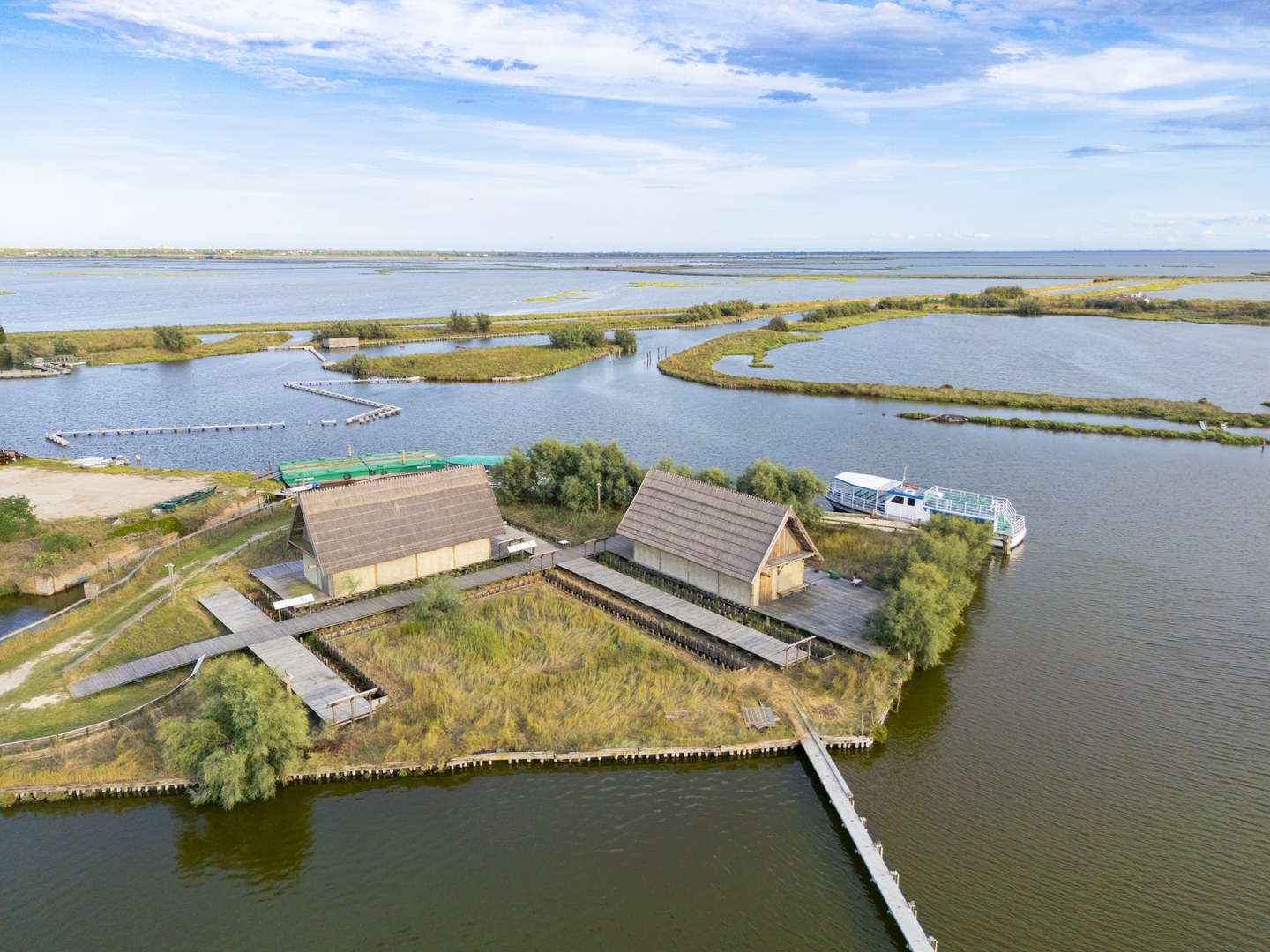
Located at Stazione Foce, at the gateway to the Comacchio Lagoons, stands the Open-Air Section of the Museo Delta Antico, which aims to reconstruct a portion of the Etruscan settlement of Spina.
The project, carried out through an experimental archaeology initiative in collaboration with the Alma Mater Studiorum – Università di Bologna and funded by the Interreg Italy–Croatia Programme – VALUE Project, allows visitors to experience firsthand what the ancient Etruscan city of Spina may have looked like.
The residential structures, reconstructed on the basis of excavation data and built entirely of wood, marsh reeds, and clay, are set within a system of internal connections that reflects the general layout of the ancient settlement, characterized by the alternation of streets and canals.
Furnished as an ancient Etruscan house, one of the two dwellings located within the park serves as an exhibition space, where visitors can admire furnishings and pottery reproduced by leading artists in the field. Accessible during guided experiences, it is also suitable for workshops and themed activities aimed at different audience groups.
The other dwelling, instead, is equipped as a teaching classroom and represents a novelty within the range of educational activities offered by the Museo Delta Antico.
The entire area is set within an environment very similar to that on which ancient Spina once stood, a place where water and land meet and blend together.
Ancient Etruscan City of Spina
Spina was one of the most important cities of Etruria Padana, founded around the mid-6th century BC along the course of the Eridanus, one of the main branches of the Po River. Its strategic position, just a few kilometers from the coastline of the time, enabled the Etruscans to control major commercial routes, and the city soon became the preferred Adriatic port for Greek ships.
Archaeological research has shown that the settlement was organized with an orthogonal system of streets and canals, oriented north–south and east–west, and divided into rectangular blocks on which the houses stood. Built mostly of wood, clay, and marsh reeds, the city has left little in the way of visible remains, but archaeological excavations continue to recover numerous artifacts that help reconstruct the history of this important center of the ancient world.
Towards the end of the 3rd century BC, Spina definitively lost its strategic importance due both to major geopolitical changes and to sudden alterations in river flows, and the ancient city literally disappeared from sight. Interest in Spina was revived in the early decades of the 20th century following the extensive land reclamation works carried out in the Comacchio area. Between 1925 and the 1950s, around 4,000 burials emerged from the large necropolises of Valle Trebba and Valle Pega.
The archaeological site of Spina, identified only in the mid-1960s during the reclamation of the Mezzano Lagoons now covers an area of about six hectares and can be visited only during excavation campaigns, which generally take place annually. Artifacts from the settlement and the necropolises can be admired at the Museo Delta Antico and at the Museo Archeologico Nazionale di Ferrara.
Contacts
Stazione Foce - 44022 Comacchio (Ferrara)


