
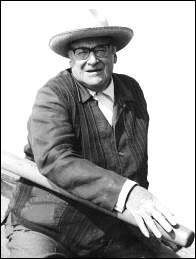
Riccardo Bacchelli
(Bologna 1891 - Monza 1985)
Narrator, poet, essayist and author of theatre scripts. In 1914, he published Poemi Lirici ("Lyric Poems") which right from the start showed his refusal of a purely contemplative treatment of poetry. He served in the First World War and at its end returned to literature.
He served in the First World War and at its end returned to literature. One of the founders of 'La Ronda', his production did not stop there and ranged from historic meditation to travel chronicles, from essay writing to biography, although his preferences lay with narrative in a large variety of forms. The historical novel is the genre that best expresses his lively interest in social history: in his 1927 work "Il Diavolo a Pontelungo" (The Devil at the Long Bridge) the attention is focussed on Bakunin's propaganda in Emilia, while the trilogy "Il Mulino del Po" (The Mill on the Po) of 1938-40, undoubtedly his best work, narrates the vicissitudes of several generations of country folk and, with a deep capacity for analysing the human soul, the age-long story of a people against the background of the great river. Among his other works stands out "La Congiura di Don Giulio" (1931), a reconstruction of the social ambience in Ferrara at the start of the 16th century which reveals Bacchelli's talent as a historian and critic.
He died in Monza and was buried in Bologna.
The most important masterpieces by Bacchelli:
- Lo sa il tonno (1923);
- Il diavolo al Pontelungo (1927);
- La congiura di Don Giulio d'Este (1931);
- Mulino sul Po (1938);
- Rossini (1941).
THE AUTHOR'S PLACES IN FERRARA
Guarda Ferrarese
The Scacerni saga takes place for the most part in the area surrounding this small town.
Ro Ferrese


