
Giorgio de Chirico
(Greece 1888 - Rome 1978)
Giorgio de Chirico was born in Volos, in Greece, in 1888, where his father worked as an engineer on the railway line Athens-Salonicco. He studied in Athens from 1903 to 1906, year of his father's death which brought the family back to Italy.
In the fall of the same year, de Chirico moved to Munich to attend Art School. He studied the masterpieces of Böcklin and Klinger and the philosophy books of Schopenhauer, Nietzsche and Weininger. In 1910 his brother Andrea (real name of Alberto Savinio) left for Paris and Giorgio went back to his mother in Florence, where he stayed for about a year before moving to Paris with his mother.
In Parigi his art developed, leaving behind the influence of the beloved German painters, and in 1912 he participated to the Salon d'Automne, showing three paintings and gaining success. He then partecipated to other exhibitions and met important artists like Picasso, Derain, Brancusi, Braque e Léger.
In 1915 he was called back to Italy because of the war and was sent to the 27th infatry regiment in Ferrara. His health was unstable, so he was allowed to do simpler tasks and could keep on painting.
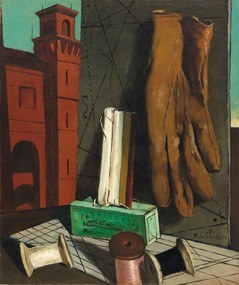
Ferrara's urbn and architectural environment played an important role in de Chirico's developement as an artist: here he painted masterpieces like "The Disturbing Muses", "Hector and Andromache", "Il Trovatore" and more. De Chirico influenced other artists like Carlo Carrà, Filippo de Pisis and his own brother Alberto Savino. These artists brought to life the short period of metaphysical painting and Ferrara is considered to be its cradle and inspiration. The main proof cn be seen in the painting "The Disturbing Muses" in which, behind de Chirico's mannequins, the Estense Castle is visible.
He died in Rome in 1978.
Some of the main masterpieces by de Chirico:
- L'enigma dell'ora (1910-1911);
- Il Canto d'amore (1914);
- The Disturbing Muses (1917);
- Hector and Andromache (1917).
THE ARTIST'S PLACES IN FERRARA
Ferrara - Piazzale San Giovanni
In the middle there is a sculpture based on a drawing by de Chirico and specifically dedicated to Ferrara.


