
Historical itinerary from Portomaggiore to Ripapersico
Transport methods
The itinerary starts from Portomaggiore at the “Ponte delle Volpi” bridge, following the “Delizie Estensi” signs that will lead you to Castello del Verginese.
Before arriving in Sandolo, you can extend your walk to Maiero, whose ancient church was destroyed during World War II. However, the bell tower dating back to 1809 remains, preserving its original appearance with its pointed spire and heavy pilasters of the belfry, as well as the “Palazzone,” the Berti ex Bergellesi palace, built in the pre-Baroque era on the ruins of the 14th-century fortress of Maiero.
Continuing along the dirt road beyond the church is the “Pozzale”: an ancient farmstead that preserves a huge 15th-century barn in excellent condition (said to be the largest in Europe).
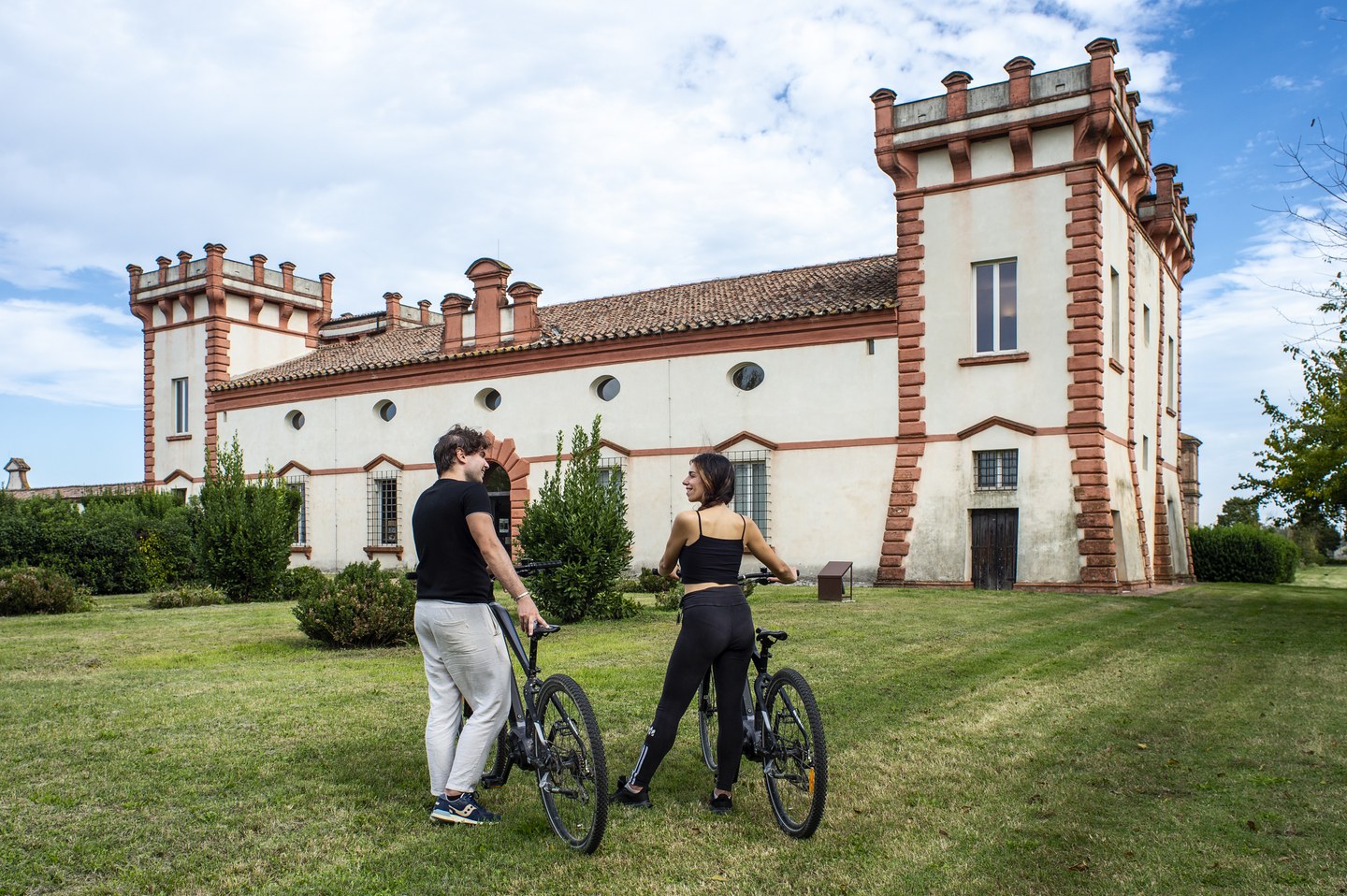
Once you reach the village of Sandolo, which owes its name to an ancient delta branch of the Po di Volano river, you can admire the Romanesque-style stone church, of which the central nave and the right nave remain today. Inside, in the presbytery, there is a Byzantine crucifix and a marble baptismal font; in the baptistery chapel, there is also a fresco of the Baptism of Jesus in the Jordan, attributed to Giuseppe Mazzolani. Finally, you will reach Delizia del Verginese, a building that was originally a farmhouse used for agricultural purposes, owned by the Este family. After 1534, it was transformed into the summer residence of Laura Dianti.
Leaving Delizia del Verginese, continue towards Gambulaga where you will find the church of S. Giorgio, which stands 24 meters high above the small town. The church stands on the site where the “castle” once stood. Built in 1777, it is shaped like a ship, with the apse representing the bow and the facade representing the stern.
The next stop is the church of San Sisto in Runco, today the only tangible sign of the ancient origins of this village. The Baroque building, dating back to 1600, houses a portrait of the patron saint attributed to Scarsellino. The image of the Madonna della Trebbia is highly venerated, having been “miraculously” found unharmed after ending up, so the story goes, in the gears of a threshing machine.
Get back on your bike and continue along the route towards Quartiere. The road winds along the dry riverbed of the Sandalo. Just outside Runco, on the left, you will notice a small house located almost in the bed of the small ditch, which is said to have once been a water mill.
In the farming village, you can visit the church dedicated to St. John the Beheaded. The next stop is Portorotta, an ancient port on the now disappeared Sandalo River. The destruction of this port, under the impetuous force of the waters, is the origin of the town's name. The village church is dedicated to Saints Giacomo and Sebastiano, but in reality it is elevated to the Sanctuary of the Madonna di Pompei. Following the ancient course of the river, immersed in the countryside, you arrive at Ripapersico.
Since the early 13th century, this small village has been a civil and religious center of primary importance in the Portuense territory. The church, dating back to the 10th century, consisted of a single nave with three altars, which over time became six, while the bell tower dates back to 1767. This church was also devastated by the bombings of April 1945, which completely destroyed both the main building and the bell tower, which were rebuilt in 1950.
After the church, keep left and follow the cycle path for just two kilometers to return to Portomaggiore, where the journey began.


