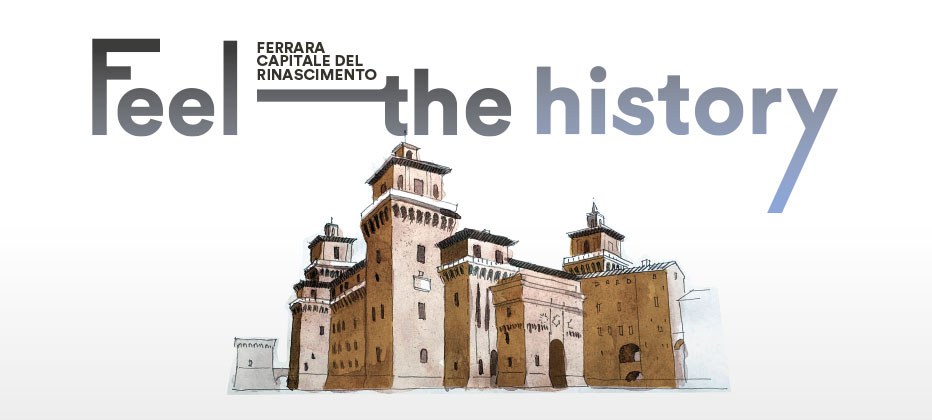
The stones of Ferrara’s Castello Estense still echo with the footsteps and voices of its former inhabitants. Its prison is where Ugo, son of Marquis Niccolò III, and Parisina, the marquis’ young wife, died after they had had a secret love affair and where Giulio d’Este, halfbrother of Duke Alfonso I, was imprisoned for 53 years. Meanwhile, on the main floor, Lucrezia Borgia, prima donna of the 16th century, and her retinue celebrated the pomp of an era when Ferrara was one of the most splendid courts in Europe, as immortalised by Ludovico Ariosto in his epic poem The Frenzy of Orlando (Orlando Furioso) and depicted by the artists of the great Ferrara school.
Starting from this majestic symbol of Ferrara, with its four towers surrounded by a moat, elegant white balustrades, prisons and rooms for court games, and following Corso Giovecca takes visitors to Palazzina Marfisa, a magnificent example of a noble residence built by Francesco d’Este, son of Duke Alfonso I and Lucrezia Borgia. Nearby is Palazzo Schifanoia, a “Delizia” conceived by Borso d’Este as a sublime place for avoiding boredom; its Salone dei Mesi boasts famous frescoes.
Other stunning palaces on this route are Palazzo Roverella, Palazzo Bonacossi, Palazzo di Renata di Francia and Palazzo Costabili, also known as Palazzo di Ludovico il Moro.
NOT TO BE MISSED
Castello Estense
The majestic symbol of Ferrara, with its four towers surrounded by a moat, red terracotta bricks, elegant white balustrades, prisons and rooms for court games and entertainment. Commissioned by Niccolò II d’Este as an imposing defensive fortress for himself and his family, it then became a magnificent courtly residence.
Corso Giovecca
Corso Giovecca is the main road that runs eastwards from the city centre and, along with Viale Cavour, divides the city in two. This ancient road is flanked by numerous buildings and places of historical importance.
Palazzo Roverella
Built in 1508 by Guglielmo Magnanini, secretary of Duke Alfonso I d'Este, it is attributed to local architect Biagio Rossetti. This magnificent building was skilfully designed for a frontal view of its lavishly decorated façade.
Palazzina Marfisa d'Este
A magnificent example of noble residence built by Francesco d’Este, son of Duke Alfonso I and Lucrezia Borgia. It was inherited by his daughter, Princess Marfisa d’Este, an art lover and patron of the poet Torquato Tasso.
Palazzo di Renata di Francia
The palace was built in the 15th century as a residence for the Este family and was designed by the architect Pietro Benvenuto degli Ordini. At the back of the building is the charming Parco Pareschi, a park surrounded by high walls, whose access is located in Corso Giovecca.
Palazzo Bonacossi
A beautiful 15th-century palace bestowed by Borso d’Este to Diotisalvi Neroni, a Florentine exile who the Duke was a patron of. In the 16th century it was part of a complex, featuring gardens and loggias, directly connected to Palazzina Marfisa d'Este and Palazzo Schifanoia.
Palazzo Schifanoia
It was Borso d’Este, first Marquis and then Duke of Ferrara, who extended the original building in the 15th century to make it a place of entertainment and recreation, to schivar la noia or avoid boredom. This Delizia Estense is home to the Salone dei Mesi and its recently-restored frescoes, one of the highest pictorial expressions of the Italian Renaissance.
Palazzo Costabili
Also known as Palazzo di Ludovico il Moro, it was commissioned by the nobleman Antonio Costabili, a leading figure in the court of Duke Ercole I d'Este, secretary of Ludovico il Moro and ambassador for the Este family in Milan. It now houses the National Archaeological Museum, with its magnificent artefacts from the Etruscan city of Spina.