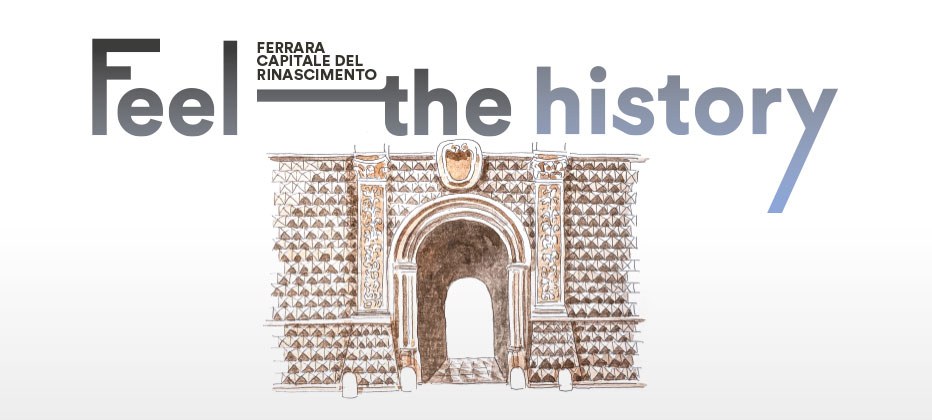
A walk through the heart of Ferrara becomes a step back into the Renaissance. The old town centre, a UNESCO World Heritage Site since 1995, is a wonderful example of a city designed in the 15th century that has remained largely intact.
From Palazzo dei Diamanti, the Este family residence so named because of the circa 8,500 diamond-shaped ashlars that cover two façades, to the great expansion of the city under Duke Ercole I, known as the Herculean Addition. In 1492, architect Biagio Rossetti conceived an urban plan that extended the centre to include all the most prestigious buildings. In terms of uniqueness and rationality, it was the “first modern city in Europe” - an ideal city, with straight, wide roads, squares, gardens and superb architecture, crossed by Corso Ercole I d’Este, known as “the most beautiful road in Europe”.
Hosting many important collections, majestic and prestigious palaces, like the Palazzo Massari complex (currently closed for restoration), continue as far as Piazza Ariostea, home to the recently-restored statue of the poet Ludovico Ariosto.
From here, it is easy to reach the huge and enchanting Tempio di San Cristoforo alla Certosa or the house once owned by the poet Ludovico Ariosto. Continuing along Corso Ercole I d’Este and heading beyond the walls leads to the other modern addition, Parco G. Bassani, the city’s “green lungs”.
NOT TO BE BE MISSED
Corso Ercole I d'Este
The main road in the Herculean Addition, it leads from the castle to Porta degli Angeli. There are no commercial businesses along it, but it is flanked by beautiful Renaissance palaces.
Palazzo dei Diamanti
An architectural triumph, designed by Biagio Rossetti and built at the heart of the Herculean Addition, on the important crossroads known as “Quadrivio degli Angeli”, it was once home to Sigismondo d’Este. Covered in about 8,500 pink and white marble ashlars, it is considered one of the masterpieces of the Renaissance.
Palazzo di Giulio d'Este
Designed by the architect Biagio Rossetti and standing on Corso Ercole I d’Este, this monumental palace once belonged to Giulio d’Este, protagonist of a dramatic event that befell Ferrara and the Este Court in the early 16th century: the plot against Duke Alfonso, which he hatched with his brother Ferrante, is remembered by the writer Ludovico Ariosto in The Frenzy of Orlando (Orlando furioso).
Palazzo Prosperi Sacrati
Built for Francesco da Castello, personal doctor of Ercole I d’Este, this is the oldest palace in the Herculean Addition. Mentioned in the ode written by Carducci, To the City of Ferrara (Alla Città di Ferrara), it boasts a magnificent monumental portal.
Quadrivio degli Angeli
The monumental crossroads between Corso Ercole I d'Este and the Corso Porta Mare - Corso Biagio Rossetti axis, it is overlooked by Palazzo Prosperi Sacrati, Palazzo Bevilacqua, Palazzo Turchi di Bagno and Palazzo dei Diamanti. Each building has a well-defined architectural significance in the urban plan of the Herculean Addition.
Addizione Erculea
In 1492, Ercole I d’Este appointed architect Biagio Rossetti to incorporate the prestigious buildings located north of Este Castle into the town centre. The architect designed the Herculean Addition, an urban plan that, thanks to its originality and rationality, made Ferrara the first modern city in Europe.
Parco Massari
This is the biggest public park within the city walls; as well as the two ancient Lebanon Cedars at its entrance, it boasts yew trees, an imposing ginkgo and an enormous English oak near the entrance on Corso Ercole I d’Este.
Palazzo Massari
This was the last important building constructed in the Este era. It was commissioned by Count Onofrio Bevilacqua in a prime urban location, between the Quadrivio degli Angeli and ancient Piazza Nova, now Piazza Ariostea.
Piazza Ariostea
An unusual oval-shaped square with a lowered floor, it’s also famous for hosting the Palio races. It was designed by the architect Biagio Rossetti and at its centre stands a column bearing the statue of the poet Ludovico Ariosto, who lends his name to the square.
Tempio di San Cristoforo alla Certosa
It was Borso d’Este who promoted the construction of a Carthusian monastery in 1452, which, after completion of the Herculean Addition, was incorporated within the walls. By order of Duke Ercole I, successor of Borso, another addition to the site was the construction of the Tempio di San Cristoforo, one of the most original works of the Renaissance period in Ferrara. It houses a marvellous collection of works of art, include paintings, wooden choirs, a ciborium, altarpieces and other liturgical furnishings.
Cimitero monumentale della Certosa
The city’s main burial site, situated within the walls of Ferrara, in the central exedra of the First Great Cloister. It boasts the tomb of Duke Borso d’Este, one of the patrons of the charterhouse. An integral part of the monumental cemetery is the Church of San Cristoforo alla Certosa, whose marble bas-reliefs, at the bases of the pillars, date from the early 16th century and portray some of the heraldic feats of the Este lineage.
Porta degli Angeli
This opens in the Rossetti walls, at the end of Corso Ercole I d'Este. Originally built as a watchtower, it was the former access to the ducal hunting estate of Barco, located where “G. Bassani” Park now stands. According to popular tradition, Cesare d’Este, the last Duke of Ferrara, was said to have exited from this gate in 1598, when the city was ceded to the Papal State.
Le Mura
The 9 kilometres of Renaissance walls that surround Ferrara combine monumental beauty and military function so magnificently that even Michelangelo came to study them. Today, they are a huge park that can be covered on foot or by bike, along handy paths that offer visitors the opportunity to walk or cycle surrounded by lush greenery and history.
Parco Bassani
Lying between the city and the Po River, it occupies a total of 1,200 hectares. Once the hunting reserve of the Este family, it has now been turned over to leisure and entertainment. Named after author Giorgio Bassani, it represents the Green Addition, the fourth in Ferrara.